
 how-to
How to Verify Auto Transport Insurance: A Step-by-Step Guide
Table of Contents
- Why Verifying Auto Transport Insurance Matters
- Understanding the Certificate of Insurance (COI)
- How to Verify Carrier Insurance Through the FMCSA Database
- How to Verify Carrier Insurance Documentation
- Evaluating Auto Transport Carrier Credentials
- Understanding Cargo Insurance Coverage Limits and Exclusions
- Red Flags That Indicate Insurance Problems
- Putting It All Together: Your Verification Checklist
- Frequently Asked Questions
Last Updated: October 9, 2026
Why Verifying Auto Transport Insurance Matters
Shipping a vehicle across state lines is a major decision, and you need to verify auto transport insurance to know the carrier actually has real coverage.
Many shippers assume any carrier with a professional website must be properly insured. Not true, some operate with minimal or expired coverage, and others skip insurance entirely.
The good news: verifying auto transport insurance is straightforward once you know what to look for.
Understanding the Certificate of Insurance (COI)
A Certificate of Insurance (COI, or "cert") is a one-page document issued by a carrier's insurance company or broker. It is not the policy itself, it is a summary proving coverage existed on the date it was printed.
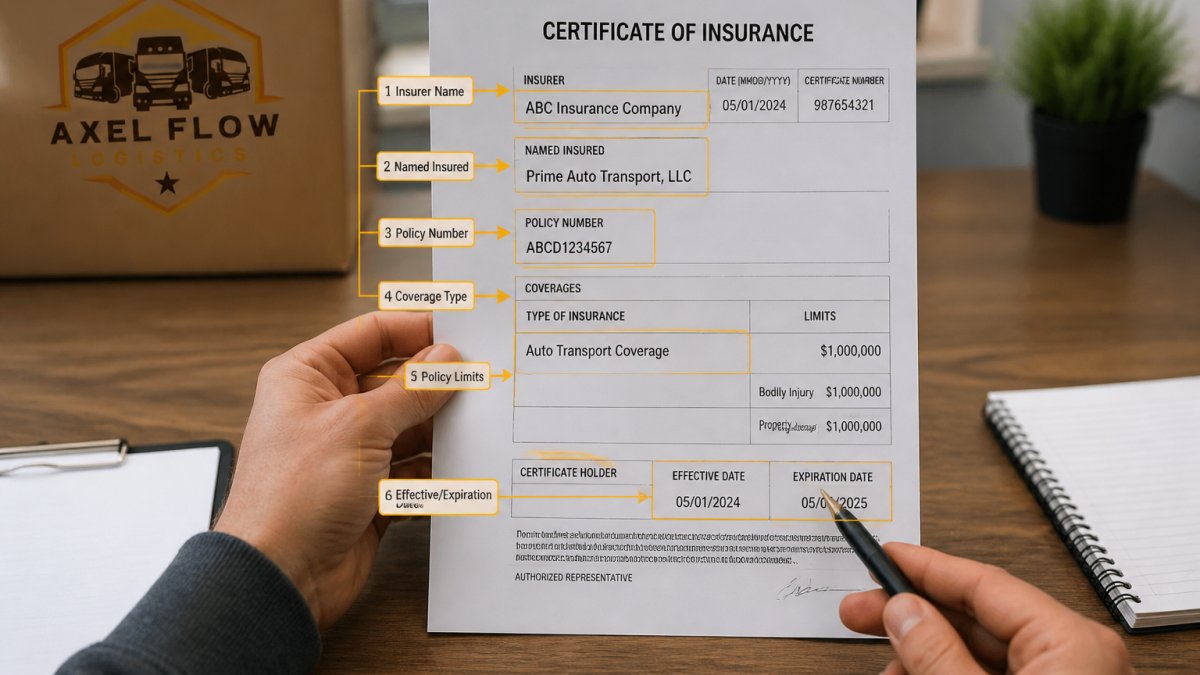
The Six Fields That Actually Matter on a COI
Layouts vary, but scan these six fields in order:
- Insurer name and A.M. Best rating. The insurer should be a licensed, admitted carrier, not an offshore shell. Check its financial strength rating through A.M. Best or the state insurance department where it is domiciled.
- Named insured. This must match the legal name of the motor carrier you are hiring, not the broker, dispatcher, or an unfamiliar parent LLC. If it's a different entity, ask why in writing.
- Policy number. Write it down. You will use it when you call the insurer to confirm active status.
- Coverage type. Auto liability and motor truck cargo are separate lines. A COI showing only auto liability does not prove cargo coverage for your vehicle.
- Policy limits. These are dollar figures, not adjectives. "Full coverage" is not a limit. Look for a specific number, such as $1,000,000 auto liability and a separate cargo limit.
- Effective and expiration dates. The policy must be active on your shipment date, not just the date the COI was printed. A COI dated within 30 days is a reasonable freshness standard.
Why the COI Alone Is Not Proof
A COI is a convenience document a carrier can request at any time, so it can be:
- Stale, issued months ago, before the policy lapsed or was cancelled.
- Cancelled mid-term, active when printed, then cancelled for non-payment two weeks later.
- Issued on a different policy, some carriers show you the policy with the highest limits while operating under a cheaper one.
Treat the COI as a lead to verify, not a guarantee.
How to Read a COI When the Carrier Sends a PDF
When the PDF arrives, open it on a desktop, zoom in on the policy number, and copy the exact characters. Then:
- Cross-check the policy number against the FMCSA record for that carrier's USDOT number.
- Confirm the named insured matches the carrier's legal name in the FMCSA record.
- Compare the cargo limit to your vehicle's actual market value, not what you paid or hope to get.
If any field is blurred, cropped, or missing, ask for a clean copy. A carrier that resists sending a legible COI is telling you something.
How to Verify Carrier Insurance Through the FMCSA Database
The Federal Motor Carrier Safety Administration maintains a public database for verifying a carrier's licensing and insurance status, your most reliable verification tool.
Access it at the FMCSA's official website and search by the carrier's USDOT or MC number, both unique federal identifiers.
The database shows whether the carrier has active authority to operate, current insurance coverage on file, safety ratings and inspection history, and any violations or complaints.
Finding USDOT and MC Numbers
Every commercial carrier operating across state lines must have a nine-digit USDOT number issued by the Department of Transportation.
The MC number (Motor Carrier number) is a separate identifier used for insurance and safety tracking; a carrier may have both or just a USDOT number.
You can find these numbers on the carrier's website (usually in the footer or "About Us" section), on the Certificate of Insurance, on your shipping quote or contract, or by calling the carrier directly.
Checking Active Authority Status
In the FMCSA results, look for Active Authority status, which confirms the carrier is legally permitted to haul freight across state lines.
A carrier with expired or inactive authority is operating illegally, and if something goes wrong you have almost no recourse.
The database also shows the carrier's safety rating. Look for "Satisfactory" or "Conditional"; an "Unsatisfactory" rating means failed federal safety inspections and should be avoided.
How to Verify Carrier Insurance Documentation
To verify auto transport insurance, requesting and reviewing actual insurance documents is your second layer of verification.
When you receive them, check for:
- Insurer name and contact information, call to confirm the policy is active
- Policy numbers, these should match the FMCSA record
- Coverage types, look for liability and cargo coverage
Then call the insurance company directly with the policy number and ask if it's active and in good standing.
Evaluating Auto Transport Carrier Credentials
Beyond insurance, other credentials matter when vetting a carrier.
Years in Business, Carriers operating 5+ years have proven they can sustain operations and maintain compliance.
Safety Inspection History, The FMCSA database shows recent inspections; multiple violations or failed inspections signal higher risk.
Complaint History, A few complaints over many years is normal; many in a short period is concerning.
Focus on carriers with satisfactory safety ratings, active authority, and clean complaint histories.
Understanding Cargo Insurance Coverage Limits and Exclusions
Cargo insurance pays when your vehicle is damaged in transit. It is separate from the carrier's auto liability policy, which covers damage the carrier causes to others' property or persons. Shippers often conflate the two, a common reason claims get denied.
How Cargo Limits Are Actually Structured
Most cargo policies are written on one of two bases:
Get a Quote →
- Per-vehicle limit. Pays up to a stated amount per vehicle regardless of how many are on the truck. A $100,000 per-vehicle limit leaves a $150,000 car underinsured by $50,000.
- Per-occurrence limit. Pays up to a stated amount for a single event, shared across every vehicle damaged. If five cars are damaged and the limit is $250,000, the payout is divided, not multiplied.
Ask which basis applies. "$1,000,000 cargo coverage" sounds impressive until you learn it's a per-occurrence limit shared across eight vehicles.
The Deductible Trap
Cargo policies carry deductibles, usually the carrier's responsibility, but some carriers pass it to shippers as a "processing fee" or deduct it from the settlement. Read your contract for who bears the deductible; if silent, ask in writing before you book.
Why Cargo Claims Get Denied
Verifying insurance is only half the job, you also need to know what voids coverage. Common denial scenarios:
1. The carrier was not the named insured. If you hired a broker or dispatch service operating under another company's authority, the cargo policy may not cover your shipment at all, which is why the COI's named insured must match the entity on your bill of lading.
2. The damage falls under a policy exclusion. Standard cargo exclusions typically include:
- Acts of God, hail, tornado, flood, earthquake. Some policies cover these; many do not. Ask specifically.
- Mechanical failure or wear and tear, if the vehicle's own components fail during transit, that is usually not a cargo loss.
- Improper loading or securing by the shipper, if you loaded personal items or modified the vehicle in a way that contributed to damage.
3. The claim was filed too late. Cargo policies have claim-filing deadlines, often 30 to 90 days from delivery; miss the window and the insurer can deny on timeliness alone.
4. The condition report contradicts the claim. The bill of lading and condition report are the primary evidence in a cargo claim; if the delivery report says "no damage" and you signed it, disputing damage later is an uphill fight.
5. The carrier's policy had lapsed by the shipment date. The COI verification process prevents this, but only if you actually call the insurer.
What to Do Before You Sign the Bill of Lading
- Photograph your vehicle from every angle, including the odometer, before pickup.
- Walk the condition report line by line with the driver and note every scratch, chip, and dent, even tiny ones.
- Confirm in writing that the cargo policy is active on the shipment date and your vehicle's value falls within the per-vehicle limit.
If a carrier can't answer basic questions about their cargo policy's limits, deductible, and exclusions, move on.
Red Flags That Indicate Insurance Problems
Watch for these warning signs of insurance or compliance issues.
COI is outdated, A COI from months ago proves nothing about current coverage.
Pricing significantly below market, A quote far cheaper than competitors may mean corner-cutting on insurance or maintenance.
No verifiable business history, No online presence, reviews, or FMCSA history is extremely risky.
Pressure to pay upfront without verification, Reputable carriers give you time to verify their credentials.
Putting It All Together: Your Verification Checklist
Use this checklist before booking any auto transport service to verify the carrier's insurance and credentials.
Step 1: Get the USDOT and MC Numbers
- Ask for their USDOT number
- Ask for their MC number (if they have one)
- Confirm both match their quote
Step 2: Search the FMCSA Database
- Enter the USDOT or MC number
- Verify "Active" authority
- Check the safety rating (should be "Satisfactory")
Step 3: Request Current Insurance Documents
- Email the carrier requesting a Certificate of Insurance dated within 30 days
- Ask for a copy of their cargo insurance policy
- Note the insurance company name and policy numbers
Step 4: Verify Insurance Directly
- Call the insurance company listed on the COI with the policy number
- Confirm the policy is active and in good standing
- Ask about coverage limits and exclusions
Step 5: Check Coverage Limits Against Your Vehicle Value
- Compare the cargo insurance limit to your vehicle's value
- If the limit is lower, ask about increased coverage
- If coverage is inadequate, contact a different carrier
Step 6: Review Red Flags
- Confirm all documents were provided without delay
- Verify no major safety violations in the FMCSA database
- Check that pricing is reasonable compared to competitors
This checklist takes 30 minutes, the difference between shipping with confidence and hoping nothing goes wrong.
Verifying auto transport insurance protects both your vehicle and your finances. When you work with a broker like Axel Flow Logistics, this verification happens behind the scenes. We vet every carrier in our network for active FMCSA authority, current insurance coverage, and clean safety records.
Frequently Asked Questions
What documents should I request to verify auto transport insurance?
Request a Certificate of Insurance (COI) from the carrier, which shows their liability coverage limits, policy expiration date, and underwriter information. Also ask for proof of their USDOT and MC numbers, a copy of their FMCSA safety rating, and documentation of any additional cargo insurance coverage. Verify that the COI lists the carrier as the policyholder and includes current dates, expired policies offer no protection for your vehicle in transit.
How do I confirm a carrier's coverage limits and deductible?
The Certificate of Insurance will list the policy limits for liability coverage and any cargo insurance. Standard liability coverage for auto transport typically ranges from $100,000 to $1 million depending on the carrier type. Check the deductible amount, higher deductibles mean you'll pay more out of pocket if damage occurs. Compare these limits against your vehicle's value; if limits are too low, the carrier may not fully cover transit damage.
How can I verify a carrier's credentials before booking?
Use the FMCSA's licensing and insurance database at safer.fmcsa.dot.gov to search by USDOT or MC number. Verify the carrier has active authority status and check their safety rating, which reflects compliance history and accident records. Request their insurance verification directly from their underwriter, not just from the carrier. Cross-reference the COI details, carrier name, policy number, and dates, with what the FMCSA database shows to ensure consistency and authenticity.
What should I do if a carrier cannot provide proof of insurance?
Do not book with that carrier. A legitimate auto transport company must carry liability insurance and cargo insurance, and should provide a COI without hesitation. If they refuse, delay, or offer excuses, it's a major red flag indicating they may operate illegally or lack proper coverage. This puts your vehicle at severe risk during transit and leaves you liable for damage. Always work with carriers who transparently share their insurance documentation before pickup.