
 how-to
Avoiding Bait and Switch Car Shipping: 2026 Guide
Table of Contents
- How Bait-and-Switch Car Shipping Works
- Car Shipping Quote Red Flags to Catch Before You Book
- How to Verify an Auto Transport Broker Step by Step
- Questions to Ask a Car Shipping Company Before Booking
- What to Do When Car Shipping Price Changes
- Building a Realistic Timeline and Contingency Plan
- Conclusion: Protect Your Vehicle and Your Wallet
- Frequently Asked Questions
Last Updated: October 5, 2026
How Bait-and-Switch Car Shipping Works
Bait and switch car shipping is a tactic where a broker advertises an unrealistically low quote to win your booking, then raises the price after your vehicle is already in transit or on the pickup truck.
The Federal Motor Carrier Safety Administration (FMCSA) regulates household goods and vehicle moves across state lines, and it publishes consumer guidance on your rights when a price changes mid-shipment. You can read the official rules at FMCSA consumer protection guidance for household goods and vehicle moves.
The core problem: a quote is not a contract price unless the paperwork says so, and most bait-and-switch cases live in that gap.
The Low Quote Trap
A low quote works because you cannot see the carrier's real cost, only the number on the screen.
The trap usually unfolds in four steps:
- A broker quotes far below the market average for your route
- You pay a deposit to lock in the "deal"
- Days before pickup, the price jumps, often framed as a "carrier fee" or "fuel adjustment"
- You either pay the new number or lose your deposit
The pressure is the point. By the time the price changes, your moving date is close and your options are thin.
Legitimate Price Changes vs. Bait-and-Switch
Not every price change is a scam, real costs move, and honest brokers explain why.
A legitimate price change usually comes with:
- A written explanation tied to a specific cost, like a route change or a terminal fee
- Advance notice, not a same-day surprise
- A clear option to cancel with your deposit refunded
Bait-and-switch looks different. The change arrives late, the reason is vague, and the only real option is to pay.
Car Shipping Quote Red Flags to Catch Before You Book
A car shipping quote is only useful if you can trust the number behind it. Before you book, scan for these red flags.
The biggest one is a quote well below every other number you collected. A price that beats the market by a wide margin is not a bargain, it is a warning.
Other signs to watch:
- No written quote, only a verbal price over the phone
- Pressure to pay a deposit immediately to "hold the rate"
- No company name, address, or FMCSA number on the quote
Warning Signs in Unusually Low Quotes
An unusually low quote is the clearest red flag in auto transport. If one number is far under the rest, ask why.
Legitimate costs do not disappear: fuel, driver time, insurance, and route distance all cost money. A quote that ignores them is either an error or a lure.
Ask the broker directly: "Is this the final price, and what could change it?" A straight answer names specific conditions; a vague answer, or a promise that "nothing will change," often sets up a later increase.
How to Verify an Auto Transport Broker Step by Step
You can verify an auto transport broker in about ten minutes using free public tools. Here is the process we walk customers through.
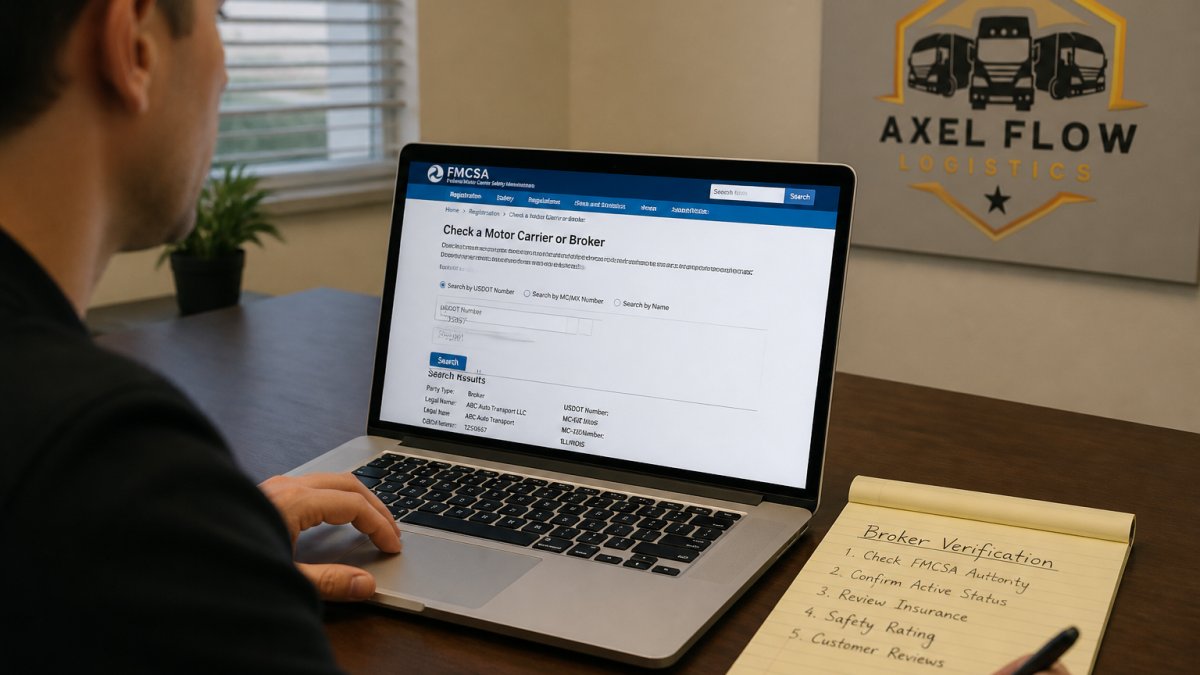
- Ask for the broker's legal company name and FMCSA number
- Look up that number in the FMCSA's public licensing database
- Confirm the license status is active, not pending or revoked
- Check the broker's insurance filing is current
- Search the company name plus "complaints" to see patterns
- Confirm the carrier assigned to your shipment is also licensed and insured
The FMCSA maintains a searchable licensing and insurance database you can use for free at FMCSA licensing and insurance database. If a broker cannot give you a number that shows up there, walk away.
FMCSA Licensing and Insurance Checks
A valid FMCSA number is the minimum bar, not a guarantee. Plenty of registered brokers still run bait-and-switch operations.
So check three things, not one:
- Licensing: The broker's authority is active
- Insurance: Coverage is on file and current
- Carrier coverage: The specific carrier moving your car carries its own insurance
That last point matters most: the broker's insurance does not cover your vehicle in transit, the carrier's does. Ask for the carrier's proof of insurance before pickup and confirm it yourself.
Questions to Ask a Car Shipping Company Before Booking
The right questions separate honest brokers from ones to avoid. Ask these before you pay anything, and listen as much for how the answer is delivered as for what is said.
- Is this quote the final price, and what specific costs could change it?
- Will I get this in writing before I pay a deposit?
- What is your cancellation policy and refund terms?
Push for written answers. A broker who will not put the price and terms in writing is telling you something.
What a Good Answer Sounds Like vs. a Bad One
A vague answer is often the setup for a later increase. Compare these side by side before you book.
| Question | Strong answer | Warning answer |
|---|---|---|
| What could change the price? | Names specific conditions: route change, vehicle not running, oversize dimensions, terminal or storage fee, seasonal carrier availability | "Nothing will change" or "we'll handle it" |
| Is this the final price? | "Yes, once the carrier is assigned and the vehicle details are confirmed in writing" | "Yes, guaranteed" with no written confirmation |
| Which carrier will move my car? | Gives the carrier's legal name and FMCSA number, or explains the assignment window and how you'll be notified | "We use a network of carriers" with no names |
| What is the cancellation policy? | States the deposit refund window, any cancellation fee, and how to cancel in writing | "Don't worry about it" or refuses to put it in writing |
| What if the carrier doesn't show? | Explains the reassignment process and whether your deposit is protected | Changes the subject |
The Quote-Comparison Worksheet
A single quote tells you almost nothing. A worksheet turns three quotes into a decision. Build one with these columns and fill it in for every provider you contact.
- Provider name and FMCSA number
- Route (origin ZIP to destination ZIP)
- Vehicle (year, make, model, running or not, modifications)
Fill in the same fields for every provider. The provider whose quote is dramatically lower than the cluster, and whose worksheet has blanks in the change, cancellation, or carrier-assignment rows, is the one to walk away from.
A common mistake is treating a friendly phone voice as proof of trust. Reviews and written terms tell you far more than a smooth sales call.
What to Do When Car Shipping Price Changes
If the price changes after you book, stop and get it in writing before you pay anything more. You have more options than it feels like, but the order matters.
Step 1: Document the Change
Before you respond, capture everything.
- Save the original written quote, the deposit receipt, and the signed contract
- Screenshot or forward every text, email, and voicemail about the new price
- Note the date and time of the call, the name of the person who called, and the exact reason given
A broker who will not confirm the new price in writing is giving you a reason to refuse it.
Step 2: Decide Whether the Change Is Justified
Not every revision is a bait-and-switch, real costs move, and honest brokers explain why. Use this to separate the two.
| Signal | Justified revision | Bait-and-switch |
|---|---|---|
| Timing | Well before pickup, with time to decide | 24 to 48 hours before pickup |
| Reason | Tied to a specific cost: route change, vehicle not running, oversize dimensions, terminal or storage fee, seasonal carrier availability | Vague "carrier fee," "fuel adjustment," or "market rate" with no detail |
| Documentation | Revised written quote you can review | Verbal only, or pressure to pay now |
| Your options | Clear right to cancel with deposit refunded | Pay more or forfeit the deposit |
| Comparison | New number still near the market cluster you researched | New number far above every other quote you collected |
If the change lands in the right column, treat it as a bait-and-switch and move to Step 3.
Step 3: Dispute the Charge and Protect Your Deposit
How you dispute depends on how you paid.
- Credit card: You have the right to dispute a charge for services not delivered as agreed. Contact your card issuer, explain that the price was changed after booking without your written approval, and provide the original quote, the contract, and your documentation. Keep the dispute within your card issuer's stated window.
- Debit card: Disputes are harder and the money leaves your account immediately. Call your bank as soon as you notice the change and ask about their dispute process.
- Cash, wire, or peer-to-peer app: These are the hardest to reverse. This is why payment method matters before you book, a deposit you can dispute is a deposit you can recover.
Send your cancellation in writing, keep a copy, and state clearly that you are cancelling because the price was changed without your written approval.
Step 4: File Complaints Where They Count
- FMCSA: File a complaint if the broker violated the terms of your agreement or operated outside its authority. The FMCSA's consumer complaint process is the starting point for federal action against a licensed broker.
- State consumer protection office: Your state's attorney general or consumer protection division handles deceptive trade practices, including bait-and-switch pricing.
- Your card issuer: A chargeback is a separate track from a regulatory complaint and can run at the same time.
Keep every complaint confirmation number. If the broker later tries to collect, those records matter.
Step 5: Find Replacement Transport Without Getting Burned Again
If your vehicle has not been picked up, you are in a better position than you think. Start over with verification: check the FMCSA database, collect at least three written quotes for the same route and vehicle details, and fill in the worksheet for each.
If your vehicle is already in transit, do not abandon it. Contact the carrier directly, its name and FMCSA number should be on your paperwork, and confirm the vehicle's location, delivery window, and who is owed what.
Contract Language and Change-Order Protections
Your transport contract is where you win or lose this fight. Before you sign, look for language that protects you.
Key protections to confirm:
- The quoted price is stated as binding, with named exceptions
- Any price change requires your written approval
- Cancellation terms and refund rules are spelled out
If the contract leaves the price open-ended, or lets the broker raise it at will, that is a change-order trap. Do not sign it.
Building a Realistic Timeline and Contingency Plan
A realistic timeline removes the pressure bait-and-switch tactics depend on. When you are not rushed, you can walk away from a bad deal.
Plan for these windows:
- Booking: 1 to 2 weeks before your move date if possible
- Pickup window: Often a range of a few days, not a single date
- Transit: Varies by route and distance
Build a contingency plan too. Keep a backup broker in mind, hold your deposit in a form you can dispute, and save every message and quote. If a price jumps at the last minute, you want options and evidence.
Conclusion: Protect Your Vehicle and Your Wallet
The gap between a low quote and a final price is where bait-and-switch car shipping lives, and closing it is mostly about paperwork and patience.
At Axel Flow Logistics, we are an FMCSA-registered and licensed broker, and we vet every carrier against safety and insurance standards before a load moves.
Get started with Axel Flow Logistics and ship your vehicle with a broker that provides transparent pricing.
Frequently Asked Questions
What is bait-and-switch in car shipping?
Bait-and-switch in car shipping happens when a broker quotes an unrealistically low price to get your booking, then raises the final price after your vehicle is already in transit. The low quote is the bait; the price increase is the switch. It often involves hidden fees, last-minute carrier reassignments, or claims that the original quote was only an estimate. Legitimate brokers provide written quotes with clear terms and only adjust prices for documented route or vehicle changes.
How can I tell if a car shipping quote is a lowball estimate?
Compare the quote against at least two or three other written estimates for the same route, vehicle type, and transport method. If one quote is significantly lower than the others, ask the broker to explain exactly what is included: fuel surcharges, insurance, door-to-door service versus terminal-to-terminal, and any seasonal fees. A quote that lacks a breakdown or seems too good to be true likely is. Legitimate brokers are transparent about what the price covers.
Should I pay a deposit before a carrier is assigned?
Most reputable brokers require a deposit to secure your booking, but you should confirm the refund terms in writing before paying. Ask whether the deposit is refundable if no carrier is assigned within your pickup window, and get the cancellation policy in writing. Some brokers only charge a deposit after a carrier is confirmed. Never pay a large upfront fee before you have a signed transport contract and a clear refund policy.
What should I do if a car shipping company changes the price after I book?
Ask for the price change in writing, including the specific reason. Legitimate changes are tied to documented factors like route adjustments, vehicle modifications, or carrier availability. If the increase is unexplained or feels like a bait-and-switch, review your contract for change-order protections. You can dispute the charge with your credit card company if you paid by card, or file a complaint with the FMCSA. Always keep copies of the original quote and all communications.